- Email: info@melbournecarremoval.com.au
- 25-27 Nicole Way,Dandenong South 3175
- Area of Operation: Melbourne-wide, VIC
24th July, 2026
That old car sitting dead in your driveway is worth more than you think. Most Melbourne car owners assume a non-runner is worth next to nothing, but the reality is that when you sell a car for parts, the combined value of its components can significantly outpace a standard scrap offer. So why do so many people still settle for less?
It’s a fair question, and you’re not alone in asking it. The idea of dismantling a vehicle yourself sounds like a nightmare, and dealing with wreckers who pay cash-in-hand can leave you on the wrong side of Victorian scrap metal laws. The repair costs to get a roadworthy certificate aren’t worth it either, and yet that car keeps taking up space.
Here’s the good news: you don’t have to pull a single bolt yourself. In this guide, you’ll discover exactly how the Melbourne parts market values your vehicle, what separates a legitimate buyer from a dodgy operator, and how to walk away with the highest possible payout, free towing included, and zero paperwork headaches on your end.
Scrap value is simple: a wrecker weighs your car, pays you for the steel, and crushes it. Salvage value is something else entirely. When you sell a car for parts, a qualified buyer assesses every reusable component, from the engine and gearbox through to the alternator, sensors, and catalytic converter. That distinction is what separates a disappointing payout from a genuinely worthwhile one.
Think of it this way. A car that weighs 1,400 kilograms might fetch a modest amount as scrap metal. But if that same car has a functioning transmission, an undamaged catalytic converter, and a set of intact suspension components, its salvage value can be considerably higher. The whole is worth less than the sum of its parts, and that’s precisely the logic behind automobile recycling as an industry.
The Melbourne market in 2026 is particularly strong for recycled components. Older model Toyotas, Fords, and Holdens are no longer in production, which means the only source of genuine replacement parts is the second-hand market. Wreckers and independent mechanics actively compete for serviceable components from these vehicles, which drives demand and, in turn, lifts the value of your non-runner.
A vehicle crosses this threshold when the cost of obtaining a Roadworthy Certificate exceeds what the car is actually worth. Statutory write-offs, a formal classification used in Victoria for vehicles with severe structural or safety damage, are common candidates. So are cars that have suffered Melbourne’s notorious hail events, transmission failures, or blown head gaskets. Repairing any of these to a roadworthy standard rarely makes financial sense. Selling the intact components does.
Every serviceable gearbox or alternator that stays in circulation is one fewer unit that needs to be manufactured from raw materials. That’s a meaningful reduction in energy consumption and emissions. Responsible dismantling also requires that engine oil, coolant, and brake fluid are drained and disposed of correctly, which protects Melbourne’s waterways from contamination. Melbourne Car Removal handles fluid extraction in line with local environmental standards, so you don’t need to worry about that side of things at all.
The environmental case for recycling aligns neatly with the financial one. A car that looks worthless in your driveway is, in reality, a collection of components that someone in Melbourne needs right now.
Not all parts are created equal. When you sell car for parts, the final payout depends heavily on which components are intact, what models are in demand, and whether your vehicle carries any high-value tech under the bonnet. Here’s what Melbourne wreckers actually prioritise.
Engines and transmissions sit at the top of the list. A serviceable engine from a late-model Toyota Hilux or Ford Ranger can be worth a substantial amount on its own, particularly as supply of genuine second-hand units tightens. Transmissions, especially automatics, follow closely behind. If either of these is still functional in your write-off, that fact alone significantly shifts your valuation.
Catalytic converters are often the single most valuable individual component by weight, because they contain trace amounts of rhodium and palladium, two platinum-group metals that command high prices on global commodity markets. Even a damaged vehicle with an intact catalytic converter is worth more than one without.
Beyond the drivetrain, wreckers pay close attention to:
This is where the Melbourne market has shifted considerably, and where most competitors are still catching up. Battery modules from Tesla and BYD vehicles are currently at a premium, driven by demand from energy storage projects and independent EV repair workshops. Electric motors and specialised thermal management systems also attract strong interest. Critically, selling a damaged EV isn’t the same as selling a conventional write-off. High-voltage systems require trained handling, which is why you need a specialist who understands EV safety protocols. Melbourne Car Removal has specific expertise in Tesla and BYD salvage, so the assessment is done correctly from the outset.
Don’t overlook what’s inside the car. Airbags and safety modules carry strict compliance requirements under Australian regulations, but intact units from popular models are actively sought by licensed wreckers. Leather interiors and premium dash components from European brands like BMW and Mercedes-Benz hold real resale value. Alloy wheels in good condition, particularly from late-model SUVs, round out the interior value picture nicely.
The combined picture is clear: a write-off is rarely just scrap. It’s a collection of components, each with its own market value, waiting to be properly assessed.
Let’s be honest about what DIY dismantling actually looks like in practice. You’ve got a dead car in the driveway, a vague plan to sell car for parts on Facebook Marketplace, and a weekend free. Sounds manageable. Fast forward three months, and you’ve got a half-stripped shell taking up space, a handful of parts that haven’t sold, and a growing sense that this wasn’t the plan you thought it was.
The driveway dilemma is real. Properly removing an engine or transmission requires a floor jack, axle stands, an engine hoist, and enough clear space to work safely. Most Melbourne residential properties don’t have that. Inner-city suburbs like Fitzroy, Brunswick, or Richmond often don’t even have a driveway at all. And if you’re renting, your landlord’s view on a disembowelled Commodore out front is unlikely to be favourable.
Then there’s the environmental side. Engine oil, coolant, and brake fluid don’t belong in Melbourne’s stormwater system, and under Victorian environmental legislation, you’re liable if they end up there. A spill during a DIY drain isn’t just messy. It’s a legal problem.
Online listings aren’t free of friction. Advertising fees, time spent photographing parts, and the sheer volume of tyre-kickers on Marketplace all chip away at your return. Selling a gearbox is straightforward enough. Selling forty individual components, each to a different buyer, is a part-time job. And once the usable parts are gone, you’re still left with a shell that costs money to dispose of. Scrap metal collection for a bare body isn’t always free, and arranging it falls entirely on you.
Working under a vehicle without a proper hoist is also a genuine safety risk. Axle stands fail. That’s not a hypothetical.
One phone call replaces all of that. A professional car removal service assesses your vehicle’s parts value upfront, gives you a lump-sum offer that reflects the full salvage picture, and handles everything from there. No listings, no negotiations, no waiting.
Free towing matters more than people realise, especially for non-runners on narrow inner-Melbourne streets where getting a vehicle out requires experience and the right equipment. Melbourne Car Removal includes towing across all Melbourne suburbs as part of the service, so there’s no deduction from your payout.
Payment comes via bank transfer rather than cash, which keeps the transaction fully compliant with Victorian scrap metal laws. Compare that to waiting weeks for individual parts to sell one by one, and the professional route isn’t just easier. For most people, it’s the smarter financial decision too.
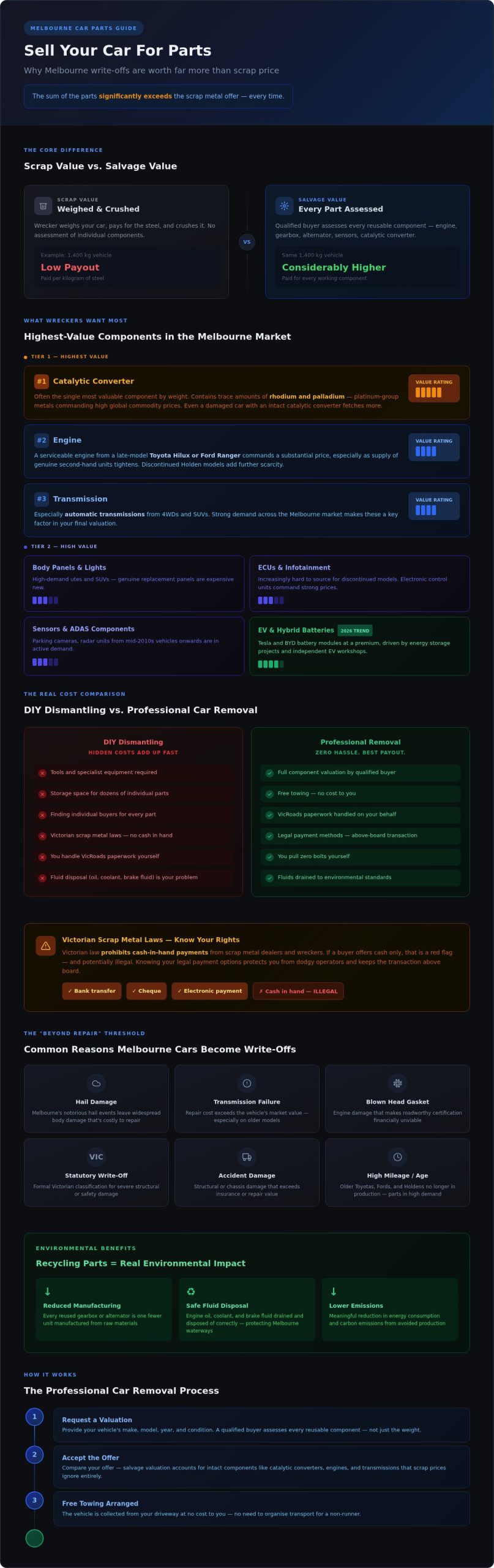
Here’s something most people don’t know until they’re standing in their driveway with a wrecker who’s offering a fistful of notes: accepting physical cash for a scrap vehicle is illegal in Victoria. Under the Scrap Metal Dealers Act 2018, no licensed wrecker or car buyer can pay you in cash for your vehicle. Full stop. Any operator who offers cash in hand isn’t just cutting corners — they’re operating outside the law, and that puts you at risk too.
Compliant payment methods are straightforward. Bank transfer or cheque are your only legal options when you sell car for parts through a licensed buyer. Melbourne Car Removal pays via bank transfer as standard, which means the transaction is traceable, documented, and fully above board. If a buyer turns up and offers cash, walk away.
In Victoria, all scrap metal transactions must be recorded with the seller’s photo ID to prevent car theft and fraud, so expect any legitimate buyer to request a copy of your driver’s licence or passport before the deal is finalised.
Before the tow truck arrives, remove your number plates. Those plates belong to you, not the vehicle. You can then use them to claim a refund on any remaining registration from VicRoads, calculated from the date you cancel. Don’t leave them on the car — once it’s gone, recovering them is your problem. If your vehicle still has finance owing, contact your lender before arranging removal. You’ll need a payout figure and written confirmation that the debt is cleared before any legal transfer can proceed.
Lost your original papers? It happens. You can still sell car for parts legally, but you’ll need to verify ownership through the Vehicle Identification Number, the 17-character VIN stamped on the compliance plate and visible through the windscreen. A VicRoads title search can confirm registered ownership in your name if documentation is missing.
Once the vehicle leaves your property, lodge a Notice of Disposal with VicRoads immediately. This is the step that formally removes your liability for the vehicle, including any fines, tolls, or incidents that occur after it’s no longer yours. Don’t skip it.
The paperwork side of things doesn’t have to slow you down. Melbourne Car Removal handles the VicRoads documentation as part of the service, so the legal loose ends are tied up without you needing to chase forms or queue at a service centre.
You’ve seen what your vehicle is actually worth. Now here’s how to get that value into your bank account without any of the usual headaches.
The difference between a standard scrap offer and a genuine parts valuation comes down to who’s doing the assessment. Melbourne Car Removal specialises in vehicles where the components carry real weight: 4WDs, SUVs, commercial vans, and trucks. These categories attract strong demand from mechanics and independent wreckers across Melbourne, and our valuations reflect that. A Toyota LandCruiser or Ford Ranger isn’t assessed the same way as a small hatchback, because the parts market doesn’t treat them the same way either.
Our service area covers all of Melbourne, from Werribee in the west through to Dandenong in the south-east, and everywhere in between. Free towing is included regardless of where you’re located. No deductions, no surprises.
The quote you receive is the amount you get. That’s the no-nonsense promise: accurate upfront valuations, zero hidden fees, and payment via bank transfer in full compliance with Victorian scrap metal laws.
Commercial vans and trucks are a strong suit. Parts demand for workhorse vehicles like the Toyota HiAce and Isuzu NPR is consistently high, which means our offers for these reflect their real salvage potential rather than a generic scrap rate.
The EV and hybrid market is where Melbourne Car Removal genuinely stands apart. Battery modules, electric motors, and thermal management systems from Tesla and BYD vehicles require trained handling and specialist knowledge to assess correctly. We have that expertise in-house. If you’re looking to sell car for parts and your vehicle is electric or hybrid, you need a buyer who understands what those components are actually worth in 2026, not someone guessing.
Got a scrap bus or heavy vehicle taking up space? We handle those too. Size isn’t a barrier; it’s an opportunity.
No listings. No tyre-kickers. No waiting weeks for individual parts to sell. Just a straightforward process from quote to cleared driveway.
Ready to clear your driveway? Get an instant quote from Melbourne Car Removal today.
Selling a non-runner doesn’t have to be a headache. You’ve seen that the real value of your vehicle lies in its individual components, not just its weight in scrap metal. Whether you have a 4WD with a solid drivetrain or a modern EV with valuable battery modules, the smartest financial move is to sell car for parts through a specialist who understands the current Melbourne market. This ensures you avoid the legal risks of illegal cash-in-hand buyers and the physical strain of trying to strip a vehicle in your own driveway.
Melbourne Car Removal makes the entire process frictionless. We provide expert valuations for all makes and models, including specialised assessments for high-tech EVs and hybrids. Our service is 100% compliant with Victorian scrap metal laws and VicRoads requirements, giving you total peace of mind. You get a fair price delivered via bank transfer and no-hassle free towing from any suburb in Melbourne.
Stop letting that damaged car take up space. It’s time to trade that burden for a high-value payout and a clear driveway. Get a Free Valuation for Your Parts Car Now and let us handle all the heavy lifting for you.
Yes, absolutely. You don’t need a Roadworthy Certificate to sell car for parts in Victoria. RWC requirements only apply to vehicles being sold for continued road use. When a vehicle is being sold for salvage or dismantling, the certificate is irrelevant. That’s one of the core reasons selling to a specialist car removal service makes sense for write-offs, non-runners, and vehicles with serious mechanical faults.
Under Victoria’s Scrap Metal Dealers Act 2018, it’s illegal for any licensed wrecker or car buyer to pay you in physical cash for a scrap vehicle. The law exists to prevent vehicle theft and fraud by keeping transactions traceable. Compliant payment methods are bank transfer or cheque only. If a buyer turns up offering a fistful of notes, that’s a red flag. Walk away. Melbourne Car Removal pays via bank transfer as standard, keeping everything fully above board.
Not at all. The whole point of using a professional car removal service is that you don’t touch a single bolt. Melbourne Car Removal assesses the vehicle as it sits, values the components in situ, and handles the entire collection process. Attempting DIY dismantling before pickup can actually complicate the valuation if key components are removed or damaged in the process. Leave the car exactly as it is and let the specialists handle it from there.
Yes. Free towing is included across all Melbourne suburbs, from Werribee in the west through to Dandenong in the south-east, and everywhere in between. Your vehicle doesn’t need to start or move under its own power. The tow is part of the service, not an added cost deducted from your payout. The quote you receive upfront is the amount that lands in your bank account.
The honest answer is that it depends on your specific vehicle. Make, model, year, and the condition of key components like the engine, transmission, and catalytic converter all influence the final figure. High-demand vehicles like Toyota Hilux utes, Ford Rangers, and late-model SUVs typically attract stronger salvage valuations than smaller passenger cars. EVs and hybrids with intact battery modules are a different category again. The only way to get an accurate number is to request a quote based on your actual vehicle’s details.
You’ll need to provide photo ID, such as a driver’s licence or passport, as required under Victorian scrap metal laws. Proof of vehicle ownership helps too, though ownership can be verified via the VIN if original papers are missing. Before the vehicle is collected, remove your number plates so you can claim a rego refund. After pickup, lodge a Notice of Disposal with VicRoads to formally remove your liability for the vehicle. Melbourne Car Removal assists with the VicRoads documentation as part of the service.
Yes, and in many cases it’s still worth more than you’d expect. Accident-damaged vehicles often retain valuable undamaged components, including the catalytic converter, underbody drivetrain parts, electronic modules, and interior trim. Statutory write-offs, the formal Victorian classification for vehicles with severe structural damage, are a common category that Melbourne Car Removal buys regularly. The salvage value is assessed on what’s intact, not on the overall condition of the shell.
Start by removing your number plates before the vehicle is collected. Those plates belong to you, not the car. Once you have them, contact VicRoads to cancel the registration. Any remaining registration period is refundable, calculated from the cancellation date. The refund is processed back to you directly. It’s a straightforward process, but the timing matters: cancel before the next renewal date to avoid paying for registration on a vehicle you no longer own.