- Email: info@melbournecarremoval.com.au
- 25-27 Nicole Way,Dandenong South 3175
- Area of Operation: Melbourne-wide, VIC
24th August, 2026
What if that massive mechanical repair bill is actually a sign to stop spending and start selling? Many Melbourne drivers believe they’re legally trapped into fixing every leak and light before they can move their vehicle on, but that simply isn’t the case in 2026. If you’re staring down a $2,000 repair quote just to get a piece of paper, you’re likely wondering how to sell car without rwc melbourne without breaking the law or your bank account.
We understand the frustration of dealing with “tyre kickers” who demand a perfect car for a scrap price, or the headache of navigating complex VicRoads transfer rules. You shouldn’t have to choose between a costly mechanical overhaul and letting a vehicle rot in your driveway. This guide promises to clear the air, showing you the legal pathways to offload your vehicle exactly as it sits today.
We’ll walk you through the current Victorian regulations, the benefits of selling to licensed motor car traders, and how to ensure you receive a fair, secure bank transfer for your 4WD, SUV, or sedan. By the end, you’ll have a clear plan to reclaim your space and your peace of mind without the stress of workshop delays or failed inspections.
A Roadworthy Certificate (RWC) is a mandatory safety document issued by a licensed vehicle tester. In Victoria, VicRoads requires this certificate to ensure a vehicle meets minimum safety standards before it changes hands. If you’re looking to sell car without rwc melbourne, you’ve likely realised that the standard path involves a fair bit of red tape. For most private transactions involving a registered vehicle, providing a valid RWC is the seller’s legal responsibility.
This inspection focuses on essential safety items like tyres, steering, suspension, and braking systems. You can find a detailed breakdown of Vehicle inspection in Australia to see how Victoria’s specific requirements compare to other states. It’s a common misconception that an RWC proves a car is in “great” condition. The test only checks safety. It doesn’t look at the engine’s health, the air conditioning, or the gearbox. You could pass a roadworthy today and have the transmission fail tomorrow.
There are specific scenarios where you cannot avoid the paperwork. You must provide an RWC when:
Timing is everything. A Victorian RWC is valid for exactly 30 days from the date of issue. This short window creates a high-pressure environment for sellers. If your buyer drags their feet or the VicRoads appointment is delayed, that certificate becomes worthless. You’ll have to pay for a completely new inspection. There’s also the risk of a second tester finding “new” faults that the first one missed, doubling your stress and your costs.
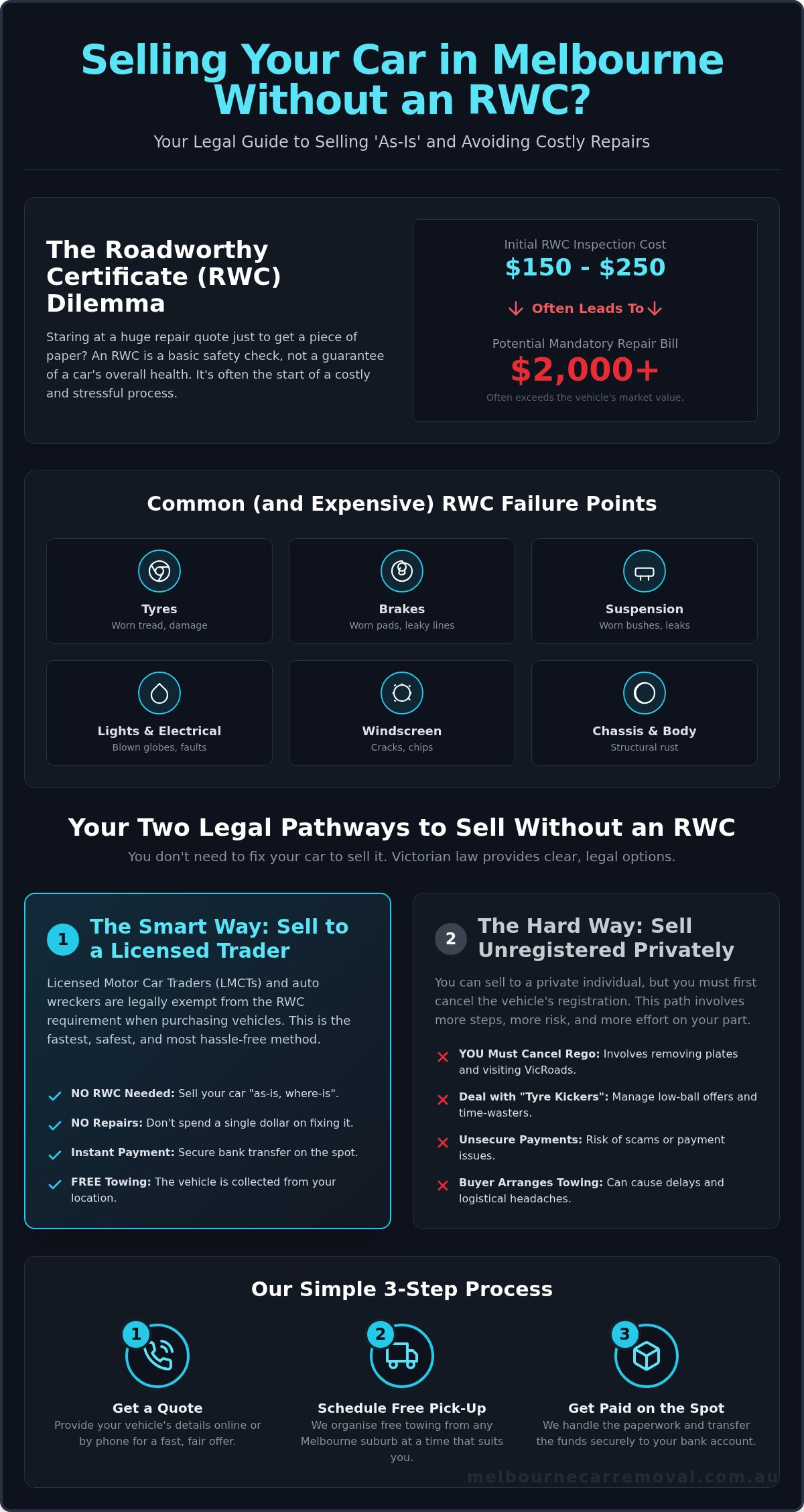
This leads many into the “cost trap.” While the initial inspection might cost between $150 and $250, the resulting repair list is the real killer. Worn suspension bushings or a slightly chipped windscreen can lead to repair quotes that exceed the car’s actual market value. When the bill hits $3,000 for a car worth $4,000, the vehicle is officially uneconomical to repair. This is why many owners seek alternative ways to sell without the headache of workshop visits.
Many Melbourne drivers believe they’re legally stuck with a car if it can’t pass a roadworthy test. This is a common myth that leads to perfectly good vehicles sitting idle in driveways. In reality, Victorian law offers several clear, legal pathways to dispose of a vehicle without a certificate. You don’t have to spend thousands on repairs just to move the car on. You simply need to choose the correct transaction type to remain compliant with the official VicRoads vehicle selling guide.
If you want to sell car without rwc melbourne, the most efficient route is bypassing the private market entirely. Private buyers usually want a “turn-key” car with registration, which triggers the RWC requirement. By shifting your focus to professional buyers or changing the registration status of the vehicle, you can finalise a sale today without ever visiting a mechanic.
Licensed Motor Car Traders (LMCTs) and professional auto wreckers operate under a specific legal exemption. They are authorised to purchase vehicles “as-is” without a Roadworthy Certificate. This is often the safest legal path for older, high-kilometre, or damaged cars. Because these businesses are professionals, the law assumes they can assess the vehicle’s safety themselves. This saves you from the “repair or scrap” dilemma, allowing you to offload the car in its current state while the buyer handles the legalities of future registration or recycling.
If you’re determined to sell to a private individual, you must sell the car without registration. This process is straightforward but requires a specific order of operations. You must physically remove the front and rear number plates and return them to a VicRoads service centre to cancel the registration. Once the car is unregistered, it is legally considered a piece of property rather than a road-going vehicle. You can then sell it for parts or as a restoration project. The buyer will need to arrange their own towing or a temporary permit to move the vehicle from your property.
While these methods are effective, they still require a bit of legwork. Many locals find that the “frictionless” choice is to request a professional car removal. This path combines the LMCT exemption with the convenience of free towing, meaning you don’t have to worry about plate returns or transport logistics. There are also rare exemptions for transfers between spouses or domestic partners, but for the vast majority of Melbourne residents, selling to a specialist or cancelling the rego are the only two practical ways to stay on the right side of the law.
Deciding to fix a car for a roadworthy is often a gamble. You might pay the initial inspection fee, which usually sits between $150 and $250 in Melbourne, only to receive a “fail” sheet as long as your arm. Common failure points include worn tyres, thinning brake pads, leaking shock absorbers, or even a small chip in the driver’s line of sight on the windscreen. While these sound minor, Melbourne’s high labour rates mean that a few hours of work can quickly spiral into a four-figure bill. If you want to sell car without rwc melbourne, you’re usually doing so to avoid this exact financial trap.
Beyond the mechanic’s bill, private sales carry the “tyre kicker” factor. These buyers often spend an hour pointing out every minor cosmetic flaw to lowball your price. Even if you spend $2,000 on RWC repairs, a private buyer will still try to haggle you down for a scratch on the bumper. Then there’s the opportunity cost. A workshop might keep your car for a week waiting for parts. In contrast, a professional car removal service can often complete the entire process within 24 hours. You save time, avoid stress, and stop throwing good money after bad.
A tiny oil leak might not bother your daily drive, but it’s an automatic fail if the tester deems it “active.” To fix a simple seal, a mechanic might need to disassemble half the engine bay. Similarly, suspension bushes are low-cost rubber parts that often require several hours of specialised labour to press in and out. It is vital to remember that an RWC check is strictly a safety assessment, not a comprehensive report on the vehicle’s long-term mechanical health. You could spend a fortune passing the safety check only for the transmission to fail a month later.
To find your true return, use this simple formula: Sale Price minus (RWC Test Fee + Repair Costs + Advertising + Your Time). For many vehicles over 10 years old, the cost of repairs actually exceeds the car’s market value. This makes the car “uneconomical to repair.” Choosing a professional car removal service often yields a better net result because you skip every single one of those expenses. You receive a secure bank transfer and immediate vehicle removal without ever lifting a spanner. It’s the most logical way to ensure you actually keep the money from the sale rather than handing it straight to a workshop.
Managing the administrative side of a vehicle sale doesn’t have to be a chore. When you decide to sell car without rwc melbourne, the legal process shifts from a transfer of registration to a cancellation of registration. This process protects you from future liability and ensures you aren’t held responsible for the vehicle once it leaves your driveway. Follow these five clear steps to finalise your sale correctly.
One of the biggest perks of selling a car without registration is the pro-rata refund. VicRoads will refund the remaining full months of your registration directly to your nominated bank account. If you have six months left on your rego, that could be a significant “bonus” payment. This extra money often helps offset a lower sale price for a non-roadworthy vehicle. To ensure a smooth payment, make sure your current bank details are updated in your VicRoads online account before you head to the service centre.
Your Receipt of Sale is your primary legal shield. It must clearly state that the vehicle is “Sold as is, no RWC.” This specific phrasing prevents the buyer from coming back to you later claiming they expected a roadworthy vehicle. It also serves as proof for toll operators or the police if the vehicle is involved in any incidents after the sale. If you want to skip the paperwork entirely, you can book your car removal online. Melbourne Car Removal handles all the necessary documentation on-site, ensuring your liability is cleared the moment the tow truck pulls away.
When your car is sitting in the driveway and the repair quotes are piling up, you need a solution that moves as fast as you do. While a private sale can drag on for weeks of haggling and failed inspections, choosing a professional removal service is the most efficient way to sell car without rwc melbourne. We’ve designed our service to be the city’s top choice by removing every obstacle between you and a finalised sale. Why wait for a mechanic who is booked out until next month when you can clear your driveway today?
We provide free towing across the entire metropolitan area. Whether you’re in the heart of the CBD, out in Geelong, or down in Pakenham, our team comes to you. We aren’t picky about what’s under the bonnet or how much dust is on the dash. We buy everything from modern electric vehicles like Teslas and BYDs to work-hardened Toyota Hiluxes and heavy-duty scrap trucks. If it has four wheels and a VIN, we’re interested. Our specialists even handle commercial fleets and buses, ensuring no vehicle is too large for us to manage.
Safety and legality are our priorities. We fully comply with the 2018 Victorian Scrap Metal Laws. This means we don’t deal in physical cash, as it’s illegal for scrap metal transactions in Victoria. Instead, we use secure electronic bank transfers. This provides a clear paper trail and protects you from the risks associated with “under the table” deals. You get the peace of mind that comes with a transparent, professional transaction that follows every state regulation to the letter.
We value your time, so we’ve stripped away the fluff. Our process is designed for maximum speed and zero stress.
You might wonder how we can legally bypass the certificate that causes so many private sellers grief. As a vehicle recycler and LMCT-aligned service, we are authorised to purchase cars specifically for salvage and scrap. We don’t need a roadworthy because we aren’t putting the car back on the road in its current state. We value your vehicle based on its salvageable components and current scrap metal weights. This allows us to offer a fair price for a car that a private buyer wouldn’t touch without a fresh certificate.
Get a free quote for your non-roadworthy car today and see how simple it is to turn that burden into a bank transfer.
You now have a clear roadmap to navigate Victoria’s 2026 vehicle laws without spending a cent on unnecessary repairs. By understanding that a Roadworthy Certificate is often an uneconomical hurdle for older vehicles, you can choose a smarter, faster path. Whether you cancel your registration at a VicRoads centre or sell directly to a licensed trader, the result is the same: a legal, stress-free transaction that puts you back in control.
If you’re ready to sell car without rwc melbourne, don’t waste another week waiting for a workshop opening. We offer a fully compliant service that follows Victorian Scrap Metal Laws, ensuring your payment is secure and your liability is cleared immediately. With free Melbourne-wide towing and same-day removal available, our team handles every logistical detail so you don’t have to.
Get an Instant Quote for Your Car Without an RWC and turn that automotive burden into a secure bank transfer today. You’re just one phone call away from a clear driveway and a much lighter mental load. It’s time to move on with confidence.
No, you cannot legally transfer a registered vehicle to a private buyer in Victoria without a valid Roadworthy Certificate. If you intend to sell car without rwc melbourne to an individual, you must first cancel the registration and return the plates to VicRoads. This converts the vehicle into an unregistered state. The buyer then takes full responsibility for obtaining a new RWC and re-registering the car under their own name.
Selling to a wrecker is the most straightforward method because they operate under a Licensed Motor Car Trader (LMCT) exemption. You simply provide proof of ownership and a valid photo ID. The wrecker handles the vehicle’s disposal or salvage under their professional licence. This legal pathway exempts you from needing an RWC. It is the ideal choice for vehicles that are damaged, old, or too expensive to repair for a private sale.
No, a vehicle does not need to be roadworthy to be sold for scrap metal. Scrap recyclers and car removal services value vehicles based on their weight in steel and the salvageable parts remaining, not their ability to pass a safety inspection. This makes it a popular choice for cars with blown engines, major body damage, or failed transmissions that would never pass a Victorian safety check in their current condition.
Your insurance policy should be cancelled or transferred as soon as the sale is finalised and the vehicle is no longer in your possession. If you’ve sold the car without an RWC by cancelling the registration, notify your insurer immediately to stop coverage. Many Australian insurers will provide a pro-rata refund for the remaining premium. This works similarly to the registration refund you receive from VicRoads after surrendering your number plates.
Yes, you can sell your car to a licensed dealer without providing a Roadworthy Certificate. Dealers are professionals who take on the legal responsibility of ensuring the car is roadworthy before they resell it to the public. This is a common way to trade in older vehicles that might need minor repairs. It saves you the time and workshop costs associated with obtaining a certificate yourself before the transaction takes place.
In 2026, a standard passenger car RWC inspection in Melbourne typically costs between $150 and $250. For larger vehicles like 4WDs, vans, or SUVs, the price generally ranges from $180 to $280. These fees are set by individual licensed vehicle testers rather than the government, so it’s wise to shop around for quotes. Remember that this fee only covers the inspection itself, not any mechanical repairs required to pass the test.
You don’t need to wash, vacuum, or detail the car before we arrive for pickup. We buy vehicles exactly as they are, meaning the cosmetic condition or cleanliness doesn’t affect our ability to remove them. All we ask is that you remove your personal belongings, E-Tags, and any rubbish from the cabin. We focus on the vehicle’s salvage value, so don’t waste your time or money on a professional detail.
To return your plates, physically unscrew them from the vehicle and take them to any VicRoads Customer Service Centre. You will need to fill out a cancellation of registration form at the counter. Once you hand over the plates, the staff will provide a receipt of surrendered plates. Keep this document safe. It is your primary proof that you are no longer liable for the vehicle’s registration or any future traffic fines.